This post made SO MUCH sense to me! I was having this experience of what felt like adrenaline surges at night with POTS- rapid heart rate, sweating, shaking, etc. Thank you for validating that POTS adrenaline surge is a thing!
Have you ever woken up in the middle of the night with your heart racing, body shaking with tremors, and with night sweats? If you have dysautonomia or another nervous system disorder, you may be facing adrenaline surges. If you thought your sympathetic (flight or fight) nervous system was already maxed out as it is, you were wrong.
Adrenaline surges, or the sudden dumping of adrenaline in your body, can happen at any time of the day with nervous system dysfunctions. For many, however, this happens most while sleeping. I often have triggers with mine: loud music, sound vibrations from movie theaters, after being scared, or even after having what I call an “active dream,” in which, for some reason, I am always doing epic parkcour.
POTS Flare vs. Adrenaline Surge
For people with Postural Orthostatic Tachycardia Syndrome, or POTS, you may be asking yourself how to distinguish between the…
I recently shared a post about compression socks on my instagram story and I had several folks reach out and ask why I wore compression socks for POTS. (If you want more information on POTS and how it’s diagnosed read my post on it here).
POTS, Postural Orthostatic Tachycardia Syndrome, is a condition where your autonomic nervous system malfunctions and doesn’t push enough blood back up when you stand up. In other words, gravity wins and pulls down more blood than your body can react against. As a response, the heart beats faster to try to pump more blood back up. Hence the tachycardia symptom.
In POTS, there can be two reasons why blood doesn’t make it back up:
Low blood volume (there’s not enough blood, so it can’t reach all the way up)
Loose blood vessels (lack of vasoconstriction doesn’t push blood back up)
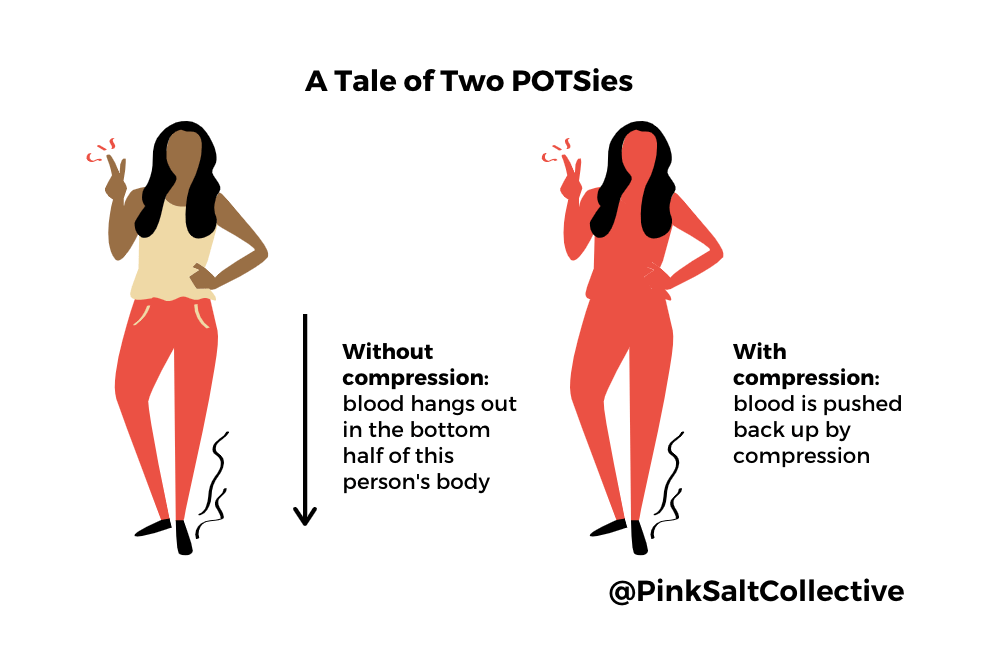
In both cases, compression can help POTS- to augment the lack of blood volume or of vasoconstriction- to push blood back up towards the head and the heart.
The impact of compression on POTS. Two people are shown, one without compression and one with compression. Both have POTS. The one with compression has more blood available to the upper body than the one without.
There are various strengths and styles of compression. Strengths can range from light (10-15mmHg), medium (15-20mmHg), strong (20-30mmHm), firm (30-40mmHg) depending on your condition and what your doctor prescribes. Styles can include knee-high, thigh-high or waist-high, and can be footed or footless. There are also abdominal binders for those who find that blood pools in their stomach region or those who feel tired after eating.
Have questions? Let me know in the comments what you’d like to see on a future post! I hope this gave you insight into why I wear compression for POTS.
Here are 20 of the top medication prescribed for POTS & Dysuatonomia. There are many POTS treatments, both pharmaceutical and non-pharmaceutical, so speak to your doctor about which POTS treatments or POTS medications are right for you.
Remember- POTS is a condition to be managed, so be wary of any site that claims that they will “cure POTS” or “cure Dysautonomia”, especially if they are charging large amounts of money to do so.
🎄 Pack medications & supplements in a carry-on rolling suitcase. Why? 1. You don’t want to check them in case it gets lost. 2. You don’t have to carry it on your back/ shoulder as you would a shoulder bag or backpack. I use a small duffel as my personal bag that I carry on top of my rolling suitcase until it’s time to board, then I put it under the seat in front of me. It holds my book, water, headphones, travel essentials. • ✨
🎄Hydrate!!! Bring bottles to fill up/ purchase extra water at the airport. Bring nuun/ liquid IV/ salt/ your favorite hydration. • ✨
🎄Eat every few hours (if you can). I find my POTS does better especially when traveling if I snack every 2 or so hours. Keeps the blood moving. •✨
🎄Plan ahead for food/ keep safe snacks on hand in case you get stuck in a hunger situation without any safe food options. It’s way less tempting to cheat on food that will make you feel crappy when you know you have safe snacks that can get you through until you can find safe food. • ✨
🎄Squeeze those muscles!! If you can, try to get up and move every hour or so. If you are stuck in a car or a window seat, try to engage several muscle groups (squeeze your buttocks, point and flex your toes, do some knee raises from your abs to work your core, squeeze your thighs) in order to pump your blood! Your legs and muscles are a natural blood pump. My blood pools a bunch when I travel due to my POTS. Compression socks help a ton too! •✨
🎄Let go of the fear of being “high maintenance”- the first time I checked a bag and did the rolling carry on/ duffel above was just a week trip to meet my boyfriends family. I didn’t want his family thinking I was “that girl” who needed multiple suitcases for a week- because it wasn’t all clothes and shoes!! But I quickly realized that I need to take care of me, period. If anyone said anything, I could shortly state it was a bag of medical items, end of story. No one said anything! 💖✨🥄🧂
What’re your favorite chronic illness travel tips? Share with me below! 👇🏻👇🏻👇🏻
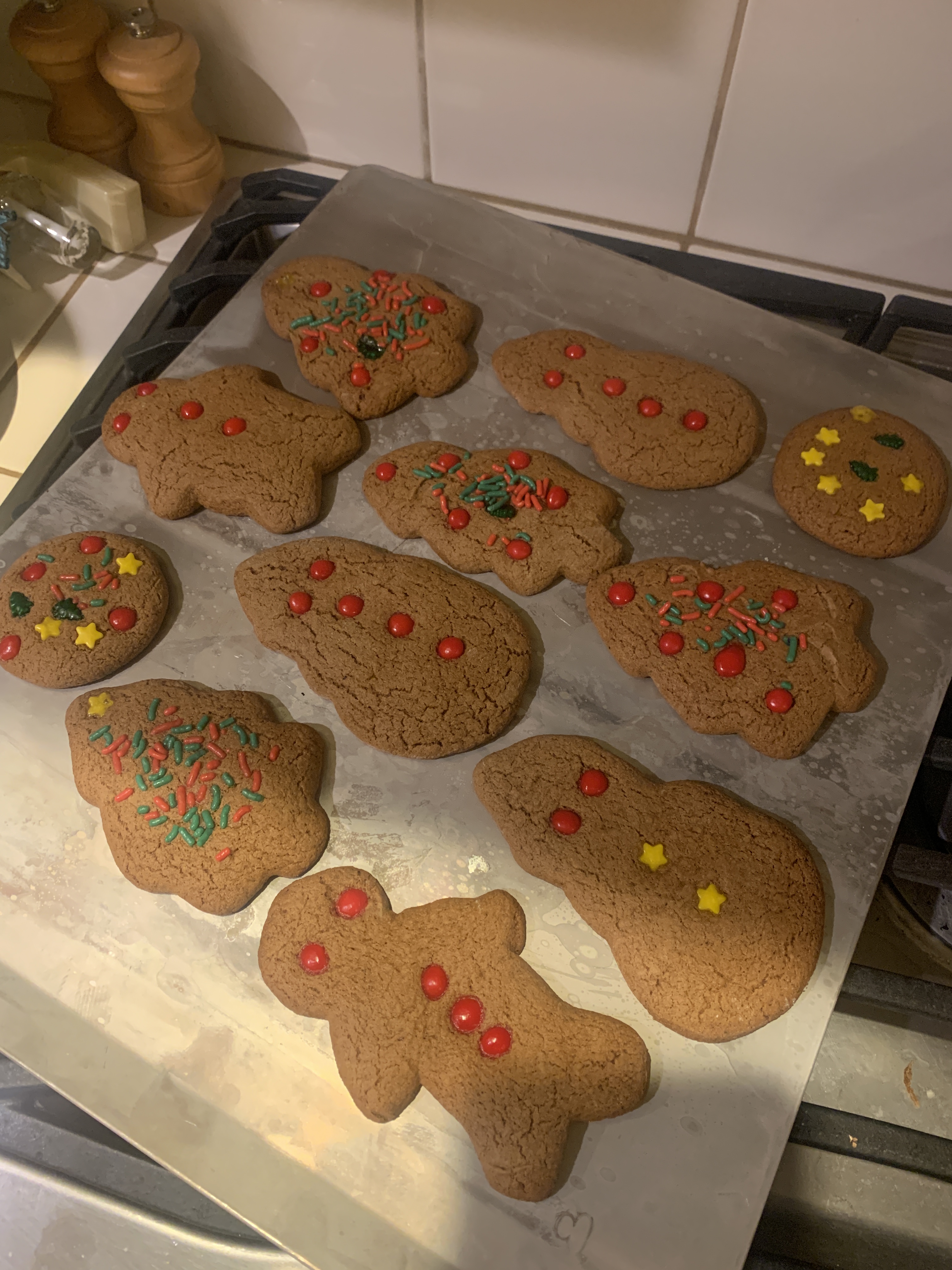
Gingerbread cookies were always my family’s favorite growing up. My mom would make them from scratch every year and use red hots for their eyes and buttons.
When I moved away from home, I took mom’s recipe with me. This year, with my chronic illness flaring, I wanted to have the magic of making homemade cookies, but didn’t want to feel ill. Thankfully it’s 2019 and with a few tweaks I was able to make them!
Now, just a few quick NOTES before we get started!:
Note 1, on flour: There are different kinds of gluten-free flour. I used a 1:1 variety by Bob’s red mill (I got mine on Amazon via Whole Foods) so that I could avoid having to add any Xantham gum or other ingredients. Make sure whatever flour you use is 1:1 OR that you have whatever additives you need to replicate ‘real’ flour consistency.
Note 2, on shortening/ butter: There are so many different shortenings and butter substitutes. I recommend finding one made of ingredients you are comfortable with (eg. some have soy, others don’t). I used this one by earth balance, soy-free. (again, from Amazon via whole foods because I got my groceries delivered #spooniewin)
Note 3, on molasses: This recipe calls for light molasses. I did some research, and it seems as though any brand of light or normal molasses should do. I recommend the Grandma’s brand, unfortunately not at whole foods, surprise! hehe. Any light or normal molasses should do, DO NOT use black strap molasses as it’s far more bitter. My whole foods only had black strap so I bought this separately.
Note 4, on spices: I always throw in a pinch more ginger and cinnamon than called for, because I LOVE spices! But rest assured if you use the measurements below you’ll be plenty flavorful!
RECIPE:
Homemade Spicy Gingerbread Men Cookies
Yield 24 cookies
5-10 min prep time, 1 hour refrigeration time, 20-30 min cutting/ baking time.
2 1/4 cups flour
1/2 cup sugar
1/2 cup shortening or butter substitute
1/2 cup light molasses
1 egg
1 1/2 teaspoons ground cinnamon
1 teaspoon double-acting baking powder
1 teaspoon ground ginger
1 teaspoon ground cloves
1/2 teaspoon ground nutmeg
1/2 teaspoon baking soda
1/2 teaspoon salt
Instructions:
In a large bowl measure all ingredients. Beat ingredients with mixer at medium speed until well mixed. Cover and refrigerate for 1 hour.
On lightly floured surface, with floured rolling pin (note: my gluten free flour didn’t stick super well so you may have to kinda wing this part), roll chilled dough 1/8 in thick. Preheat oven to 350 degrees F.
With cookie cutters, cut out desired shapes. Reroll trimmings and cut again. With spatula, place 1/2 in apart on cookie sheets.
On each cut out, use sprinkles, cinnamon red hots, or desired decor to embellish cookies. Or omit and use frosting to decorate after (frosting not included in recipe)
Bake 8 minutes or until browned, then with spatula remove cookies to cooling rack.
One of the first things many POTS patients are told to do is to get compression stockings or compression socks. But what does that mean? Where do you begin?
I have very sensitive skin and a low pain tolerance as well as a low what I call ‘tight clothes’ tolerance, and below I’ll share my experience with compression socks and stockings, what was comfortable, how they helped and what I recommend. Note: I get zero commission or buy back from this, just sharing my own advice!
Quick Note on the Growing Popularity of Compression Socks: There are more and more ‘fad’ compression stocking companies coming out. Unless the socks or stockings explicitly list the compression level (20-30mm is recommended for POTS), I would save your money and avoid these.
First of all, compression socks/ stockings DO NOT have to be ugly or uncomfortable. Trust me- there are MANY uncomfortable and ugly varieties- just walk down the compression aisle at your local drugstore. But as anyone with chronic illness knows, the key to any aid is comfort and utility, and that’s what I’ve found in the following compression garments.
Disclaimer: These are just what worked for me. Everyone is different (and everyone’s POTS symptoms are different, so these may not work for you and that’s ok)
How Much Compression Do I Need?
A minimum of 20-30mmHg is the recommended compression level for POTS patients. If this is your first time wearing compression garments, you could start with a 15-20mmHg to get used to them. Some folks don’t like the feel or need to get used to it, and that’s entirely ok. 30-40mmHg is recommended as well, if you can tolerate it. I find that the material on many full-length compression garments at 20-30mmHg isn’t the most comfortable, so I don’t like to go any higher than that.
Knee High, Thigh High or Full Length?
I have both knee high and full length. Personally, since I have such sensitive skin, thigh high will leave a mark at where it hit my thigh and be very uncomfortable, but some people like them.
I tend to use my knee high ones for everyday wear, working out, and when I just want to throw on compression without a whole ordeal of getting the waist-high ones on (sometimes its my cardio for the day!)
I wear full-length pantyhose stockings when I go to a full day of work and feel I need more support than knee-high.
My knee highs are softer sock material. I have full length tights as well as pantyhose. I prefer the pantyhose because they’re actually softer than the tights, and thinner. I can fit my full length allegro pantyhose 20-30mmHg under my skinny JCrew and Madewell jeans- no one knows I’m wearing them! Score! Cute outfits in tact!!
Bonus: The above stockings are on sale for $21! I have had mine for a year and they just wore out!
Footed or Footless Tights and Pantyhose?
Both!! I have one pair of footed pantyhose that I ordered to try them out and ended up loving. I found that I wanted to wear them to work under dresses in the summer with sandals, so I needed them not to be footed. Thankfully my favorite pair comes in footless too so I snagged a pair of those!!
I also recently ordered some sheer knee high footless sleeves as well. Some days I don’t feel like wrestling on the full leg compression but want to wear, say jeans with sandals, and I needed to not have toes on mine. I got the same brand as my socks, just the calf sleeves! Think about the color though, I ordered hot pink and bright teal, and should have gotten black for work! Haha! Now i just walk around with jeans and hot pink sleeves sticking out from them. Once my coworker asked me if I was wearing a wetsuit under my clothes! lol!
Final Thoughts
I hope this was helpful! What questions do you have about compression socks? I’ll be posting more about how they’ve helped me and my experience!
Question 1: I’m new to working out with POTS! What are some exercises to start? Just getting from bed to the next room is hard now.
Answer:
Hi there! Good news: working out can be HELLA LAZY! Here are some of my favorite floor-bound exercises based on the goal.
Goal: Muscle Tone
Exercise 1: Doggy Glutes
Begin on your hands and knees. Keeping your left knee on the ground, raise your right bent knee so that your thigh makes a straight line from your hip to your knee. Engage your glute. Lower your knee back down to the starting position. For an added challenge, don’t rest it when it gets back down. Repeat 10 times, then on the other leg.
Exercise 2: Doggy Glutes 2- Straight Leg
Begin on your hands and knees. Keeping your left knee on the ground, raise your right bent knee so that your thigh makes a straight line from your hip to your knee. Engage your glute. Now, straighten your leg but keep your foot flexed. Keeping your abs engaged, lower your leg just an inch or two, feeling the glute doing all the work. Raise it back up. Repeat this tiny motion 10-20 times. Repeat on the other side.
Goal: Slight Cardio
Exercise 1: Doggy Limb Raises
Begin on your hands and knees. Shift your weight to your right arm. Raise your left arm straight in front of you until it is level with your ear. Slowly bring it back to the starting position. Repeat with your left arm, then your left arms and legs.
Bonus Level: Try doing this with your right arm and left leg at the same time, then the left arm and right leg at the same time
Question 2: I have mastered medium level floor workouts, but can’t seem to work up to running! What do you recommend?
Disclaimer: Everyone’s POTS is different, and everyone’s body is different. This is just what worked for me, but I am happy to share it!
I started on the recumbent bicycle, level 1. I worked up to 20 minutes, then worked up to level 4 or so. I decided I felt strong enough to try the stationary bike. I worked up to 20 minutes on this (level 1 and first, then up to 4), then would start the following on different days.
Workout 1: 10 min recumbent bike, 5 min elliptical, 5 min recumbent bike (did this for 2-4 weeks)
Workout 2: 10 min recumbent bike, 10 min elliptical (did this for 2-4 weeks)
Workout 3: 5 min recumbent bike, 15 min elliptical (you could start jogging here, I get shin splints so at this point I could only elliptical)
Workout 4: 10 min recumbent bike, 10 min walk/ jog
Workout 5: 5 min recumbent bike, 15 min walk/ jog
Workout 6: 20 min walk/ jog
NOTE: this wasn’t always linear! Some days I felt horrible and stepped back to workout 1 after I had been on workout 5. And that is OK. This still happens- some days I can run 4 miles, others I can’t even get out of bed. Accept where you’re at. You’ve got this.
A beautiful illustration of chronic illness, doubting your own experience, and how to overcome. Text pasted below, original article linked below as well. Original author Stephanie Harper.
Health and wellness touch each of us differently. This is one person’s story.
It’s been 10 years since a slew of still unexplained symptoms invaded my life. It’s been 4 1/2 years since I woke up with a headache that hasn’t ever gone away.
In recent months, I’ve become increasingly sick — all of my symptoms attacking at once and new symptoms appearing what seems like daily sometimes.
For now, my doctors have settled on new daily persistent headache and ME/CFS as tentative diagnoses. My team of doctors are still running tests. We’re both still searching for answers.
At 29 years old, I have spent almost a third of my life chronically ill.
I can’t remember what it was like before — to not feel some combination of these symptoms on any given day.
I live in a state that’s equal parts cautious optimism and hopelessness.
Optimism that answers are still out there, and a sense of acceptance that, for now, this is what I have to work with and I will do my best to make it work.
And yet, even after all these years of living and coping with chronic illness, sometimes I can’t help but let the strong fingers of self-doubt reach in and take hold of me.
Here are some of the doubts I continually wrestle with when it comes to how my chronic illness affects my life:
1. Am I sick or just lazy?
When you’re sick all the time, it’s difficult to get things done. Sometimes, it takes all of my energy just to get through the day — to do the bare minimum — like get out of bed and take a shower, do laundry, or put the dishes away.
Sometimes, I can’t even do that.
My fatigue has had a profound effect on my sense of value as a productive member of my household and society.
I’ve always defined myself by the writing I put out into the world. When my writing slows, or comes to a halt, it makes me question everything.
Sometimes, I worry that I’m just straight-up lazy.
Writer Esme Weijan Wang put it best in her article for Elle, writing, “My deep fear is that I’m secretly slothful and am using chronic illness to disguise the sick rot of laziness within myself.”
I feel this all the time. Because if I really wanted to work, wouldn’t I just make myself do it? I would just try harder and find a way. Right?
When any kind of physical activity, even just standing for long periods of time, causes my symptoms to spike uncontrollably, it’s hard to hear these requests that lack empathy.
Deep down, I know that I’m not lazy. I know that I do as much as I can — what my body allows me to do — and that my whole life is a balancing act of trying to be productive, but not overdo it and pay with exacerbated symptoms later. I’m an expert tightrope walker.
I also know that it’s hard for people who don’t have these same limited energy stores to know what it’s like for me. So, I have to have grace for myself, and for them as well.
2. Is it all in my head?
The hardest thing about a mystery illness is that I find myself doubting whether or not it’s real. I know the symptoms I’m experiencing are real. I know how my illness affects my daily life.
At the end of the day, I have to believe in myself and what I’m experiencing.
But when nobody can tell me exactly what’s wrong with me, it’s hard not to question if there’s a difference between my reality and actual reality. It doesn’t help that I don’t “look sick.” It makes it hard for people — even doctors, sometimes — to accept the severity of my illness.
There are no easy answers to my symptoms, but that doesn’t make my chronic illness any less serious or life-altering.
Clinical psychologist Elvira Aletta shared with PsychCentral that she tells her patients that they just need to trust themselves. She writes: “You are not crazy. Physicians have referred many people to me before they had a diagnosis, even doctors who don’t know what else to do for their patients. ALL of them eventually received a medical diagnosis. That’s right. All of them.”
At the end of the day, I have to believe in myself and what I’m experiencing.
3. Are people tired of me?
Sometimes I wonder if the people in my life — those who try so hard to love and support me through all of this — ever just get tired of me.
Heck, I get tired of all of this. They have to be.
I haven’t been as reliable as I was before my illness. I flake out and turn down opportunities to spend time with the people I love, because sometimes I just can’t handle it. That unreliability has to get old for them, too.
Being in relationships with other people is hard work no matter how healthy you are. But the benefits always outweigh the frustrations.
Chronic pain therapists Patti Koblewski and Larry Lynch explained in a blog post: “We need to be connected to others — don’t try to fight your pain alone.”
I need to trust that the people around me, who I know love and support me, are in it for the long haul. I need them to be.
4. Should I be doing more to fix it?
I’m not a doctor. So, I’ve accepted that I’m simply not capable of wholly fixing myself without the help and expertise of others.
Still, when I wait months between appointments and am still no closer to any kind of formal diagnosis, I wonder if I’m doing enough to get well.
On the one hand, I think I have to accept that there really is only so much I can do. I can try to live a healthy lifestyle and do what I can to work with my symptoms to have a full life.
I also need to trust that the doctors and medical professionals I work with do have my best interest at heart and that we can continue to work together to figure out exactly what’s going on inside my body.
On the other hand, I have to continue to advocate for myself and my health in a complex and frustrating healthcare system.
I take an active role in my health by planning goals for doctor’s visits, practicing self-care, like writing, and protecting my mental health by showing myself self-compassion.
5. Am I enough?
This is perhaps the most difficult question I wrestle with.
Is this sick version of me — this person I never planned to be — enough?
Do I matter? Is there meaning in my life when it’s not the life I wanted or planned for myself?
These aren’t easy questions to answer. But I think I have to start with a change in perspective.
My illness has affected many aspects of my life but it hasn’t made me any less “me.”
In their post, Koblewski and Lynch suggest that it’s okay to “Grieve the loss of your former self; accept that some things have changed and embrace the ability to create a new vision for your future.”
It’s true. I’m not who I was 5 or 10 years ago. And I’m not who I thought I was going to be today.
But I’m still here, living every day, learning and growing, loving those around me.
I have to stop thinking that my value is based solely on what I can or cannot do, and realize that my value is inherent in just being who I am and who I continue to strive to be.
My illness has affected many aspects of my life but it hasn’t made me any less “me.”
It’s time I start realizing that being me is actually the greatest gift I have.
Stephanie Harper is a writer of fiction, nonfiction, and poetry currently living with chronic illness. She loves traveling, adding to her large book collection, and dog-sitting. She currently lives in Colorado. See more of her writing her atwww.stephanie-harper.com.



 Pink Salt Collective